
Have you ever done the math? In China, a full-face treatment with 900 hairs using the genuine Thermage FLX device costs 18,000 yuan in second-tier cities, and in first-tier cities, you might even have to wait in line for 25,000 yuan without guaranteed access to a chief physician. With the same machine, the same probes, and the same number of hairs, a treatment using the American version of the Thermage FLX device with 600 hairs costs a minimum of 1.09 million Korean won (about 5,600 yuan), while 900 hairs would cost around 2.5 to 3.6 million Korean won (about 13,000 to 20,000 yuan) – the difference is not just in the hundreds or thousands of yuan, but in tens of thousands of yuan.
What’s even more frustrating is that in South Korea, the Oligio (the Korean version of Thermage) costs only 1.5 to 2 million Korean won per 300 treatments, which is approximately 7,800 to 10,400 yuan. In contrast, similar Korean radiofrequency treatment options in China cost anywhere from 4,000 to 7,000 yuan per treatment, and the number of treatments offered is also significantly less than in South Korea. The most advanced anti-aging devices in South Korea are at least 300,000 Korean won cheaper than those available in China. Why is that?
The answer lies in a fundamental logic that many people fail to understand: the origin of medical beauty equipment is not in China, but in South Korea and the United States. Devices produced locally in South Korea, such as Lutronic, Hironic, and INTROmedic, are exempt from international freight costs, import duties, and the additional markups associated with multiple levels of distribution channels. When you purchase such equipment in South Korea, you are getting the “factory price directly”.
Today’s article delves into the five key reasons behind the low cost of medical aesthetics treatments in South Korea. After reading it, you will understand that it’s not so much that South Koreans are engaged in charitable activities, but rather that the entire industry chain has developed much more rapidly.
I. Why is South Korea the “origin” of high-end medical beauty equipment? 🇰🇷 Why are medical beauty treatments in South Korea so inexpensive? First, let’s understand who is capable of producing this equipment.
The global market for medical beauty equipment is not something that just anyone can enter into. Lasers, radiofrequency, ultrasound – each of these technologies requires the integration of advanced optical systems, radiofrequency electronics, and cooling systems. There are only a handful of countries capable of independently developing and mass-producing such equipment: the United States, South Korea, Israel, Germany, and Japan.
South Korea is precisely the country that has taken “mass production” to its ultimate level in this regard.
1. South Korea’s domestic instrument brands rank among the top three in the world.
Let’s take a look at the list of local equipment brands from South Korea – each of them has made a name for itself in the global medical aesthetics market.
- Lutronic is among the top five manufacturers in the world in terms of global shipments of Pico lasers and fractional lasers. Many Spectra Pico lasers used in Dermatology clinics in China are produced by this company.
- Hironic – Globally authorized distributor of dual-wavelength Pico devices, with agents in Japan, Europe, and Southeast Asia.
- INTROmedic, the development company behind Oligio (the South Korean version of Thermage), has been authorized by Solta Medical of the United States to manufacture Oligio directly in South Korea.
- Classys is the manufacturer of Shurink (the Korean version of HIFU), and it holds a leading position in the Asian market.
- Jeisys Medical is the parent company of Potenza, the manufacturer of Potenza Potenza and Density Filler injection devices.
Do you see clearly? Products like Oligio, Shurink, and Liftera – these “Korean alternatives” – are all developed, produced, certified, and manufactured entirely in South Korea. An Oligio device used in a clinic in Gangnam District, Seoul, can be installed on the same day it leaves the factory. There’s no need to travel halfway around the world, no need to go through customs procedures, and no need to wait for import approvals.
2. Buying equipment in the country of origin eliminates three major cost factors.
For the same Thermage FLX device, the procurement processes in South Korea and China differ significantly.
| Purchasing process | South Korea clinics | Chinese clinics |
|---|---|---|
| Factory price | Factory price of Solta Medical in the United States | Factory price of Solta Medical in the United States |
| International logistics + insurance | ✅ Yes (from the United States to South Korea) | ✅ Yes (from the United States to China) |
| Import tariffs | Lower (Korea-US FTA Agreement) | Higher (tariffs on medical devices + VAT) |
| Regional distributors add markups. | Relatively less (due to the large size of South Korea’s market and high volume of shipments, the profits for agents are relatively low). | To a greater extent (although the Chinese market is large, it has many intermediate levels of distributors, and each level takes a commission). |
| Arriving at the clinic | Approximately 800,000 RMB per unit | Approximately 1 to 1.2 million RMB per unit. |
For products such as Oligio, Shurink, and Liftera that are locally manufactured in South Korea, clinics in South Korea can directly purchase them from the factories. There are no international logistics costs, no import tariffs, and no markups added by general agents – all three major cost factors are effectively eliminated. This is precisely why the cost of a South Korean-made HIFU device like Liftera can be only one-third of the price of similar domestic devices, or even lower.
3. In South Korea, medical equipment is updated and replaced rapidly, and the release of second-hand devices into the lower-end market also helps to keep prices low.
In the Dermatology departments of Gangnam District, the average replacement cycle for medical equipment is only 12 to 18 months. Once new models are released, the old equipment is sold to lower-tier clinics or branch offices in Busan or Daegu at prices close to their residual value. This entire equipment circulation system enables clinics at all levels to operate with lower equipment costs. In contrast, domestic clinics have to use the same equipment for 3 to 5 years before it begins to depreciate, resulting in naturally higher equipment costs per treatment.
II. How big is actually the price difference between Thermage treatments in South Korea and those in China? 💰 Why are medical beauty treatments so much cheaper in South Korea? Let’s look at the numbers directly.
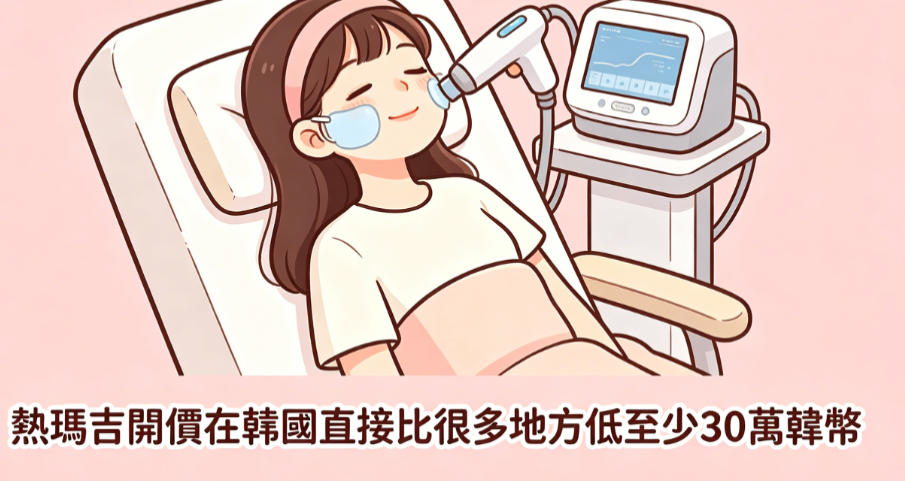
The BARUNGYN treatment is undoubtedly the most frequently asked about service in the medical aesthetics industry, and it also represents the most significant price difference between China and South Korea. Let’s take a look at some real figures:
| Hot Maggie version | South Korea prices (in Korean won) | Convert to RMB | Domestic reference price (RMB) | Price difference |
|---|---|---|---|---|
| The American version of Thermage FLX: 600 treatments in total | ₩2,200,000 | Approximately 11,660 yuan | 18,000 to 25,000 yuan | Starting from a minimum of 300,000 Korean won (approximately 1,600 yuan), and going up to a maximum of 1 million Korean won. |
| The American version of Thermage FLX emits 900 pulses per second. | ₩2,500,000 to ₩3,600,000 | Around 13,000 to 20,000 yuan | 28,000 to 35,000 yuan | Starting from around 15,000 yuan upwards |
| 100 cartridges of Oligio, the Korean version of Thermage | ₩190,000 to 200,000 | Around 1,000 yuan | 1,500 to 2,500 yuan | Around 50-60% lower |
| Oligio Oligio 300 Shots | ₩1,500,000 to 2,000,000 | Ranging from approximately 7,800 to 10,400 yuan | 4,000 to 7,000 yuan | Note: In China, the number of hair transplants usually ranges below 100; in South Korea, it starts at 300. |
The Thermage FLX has a capacity of 600 treatments. In South Korea, the lowest price can be found at the DIORE CLINIC, where it costs 1.09 million South Korean won (approximately 5,600 yuan), while in China, the same number of treatments would cost at least 18,000 yuan. The difference amounts to approximately 12,400 yuan, which is equivalent to roughly 2.34 million South Korean won – a significant savings that is even greater than the total cost of a round-trip flight and three nights in a five-star hotel.
This is precisely the logic behind “at least a savings of 300,000 South Korean won”. It’s not an exaggeration; it’s a fact.
1. Why can the price of Thermage in South Korea be so low?
Firstly, the demand for Thermage in South Korea is incredibly high. Local consumers in South Korea have the highest acceptance of medical aesthetics treatments in the world; Thermage has almost become a “standard feature of the middle class” there. It is completely normal for women over 40 to undergo Thermage treatment once a year. This immense demand has made South Korea one of Solta Medical’s largest single markets in Asia. You can get discounts when purchasing Thermage devices in bulk on Amazon, and the same logic applies in South Korean clinics – bulk purchases of probes and consumables result in significantly lower per-unit costs compared to China.
Secondly, the cost structure of these probes is completely different. Thermage probes are disposable items; each time one is used, another one is consumed. In South Korea, the prices are determined based on bulk purchases of several thousand units per month. However, domestic agents purchase much smaller quantities, so the cost per probe is significantly higher.
2. The Oligio version of the Korean Hot Maggi goes even further in terms of exaggeration.
Oligio is the version produced locally in South Korea by the South Korean company INTROmedic after obtaining the licensing rights from Solta Medical. It eliminates the costs associated with international freight, import duties, and cross-border agency commissions – the entire production process takes place entirely within South Korea. The factory price is directly the same as the price at which clinics can purchase it, with only one level of logistics involved in the distribution process.
3. Objective reminder: Low prices don’t necessarily mean you can choose without thinking.
In South Korea, there are also cases where counterfeit cameras or second-hand cameras are reused. When choosing a clinic, it is essential to verify the following: that the equipment can be scanned for authenticity verification, that the cameras are opened in front of you, and that they are equipped with a “Medical Device Manufacturing License Number”. Any institution that refuses to provide these certifications should be immediately excluded.

III. Besides Thermage, what other devices are more than 50% cheaper in South Korea? 📊 Why are medical beauty treatments so much cheaper in South Korea – a comprehensive comparison of price differences
Thermage is just the tip of the iceberg. When you compare the prices of medical beauty devices from South Korea, you will find that almost none of them are more expensive than those from South Korea. Here are the actual price differences for some key products in the medical beauty industry between China and South Korea in 2026:
| Project Name | South Korea prices (in Korean won) | Convert to RMB | Domestic reference price (RMB) | Price difference multiplier |
|---|---|---|---|---|
| Ulthera HIFU for the entire face | ₩376,000 | Approximately 1,810 yuan | 6,000 to 8,000 yuan | Approximately 3.3 times |
| Korean version of Liftera HIFU | ₩42,000 | Around 203 yuan | Over 1,500 yuan | About 7 times |
| LDM Droplet Lifting/Repair | ₩37,000 | Around 180 yuan | Above 3,800 yuan | About 21 times |
| XE-LHA Peel for Radiant Skin | ₩66,000 | Around 320 yuan | Over 1,200 yuan | Approximately 3.8 times |
| 3ml Basic Glow Injection | ₩99,000 | Around 478 yuan | 1,200 to 2,000 yuan | Approximately 2.5 to 4.2 times |
| Juvelook Natural Beauty Needle | Starting from ¥210,000 | Starting from around 1,100 yuan | 2,500 to 5,000 yuan | Approximately one-half to one-third |
| Rejuran PN | ₩270,000 to 400,000 | Approximately 1,430 to 2,120 yuan | 2,980 to 6,000 yuan | Save 60-75% |
| Inmode FX Double Chin | ₩280,000 to 650,000 | Ranging from approximately 1,500 to 3,500 yuan | 4,800 to 8,000 yuan | Save 55-68% |
| ONDA Ultra-Microwave 60 kJ | ₩400,000 to 650,000 | Around 2,100 to 3,500 yuan | 5,000 to 8,000 yuan | Save 55-60% |
1. The prices of Korean-made medical devices are truly astonishingly low.
The Korean version of the Liftera HIFU costs 203 yuan, while the domestic version costs 1,500 yuan – a difference of 7 times. The LDM water-drop repair treatment costs 180 yuan in South Korea, but 3,800 yuan in China, a difference of 21 times. This is not just a “slightly lower price”; it’s actually a “price difference on a completely different order of magnitude”. The fundamental reason for this lies in the core argument of this article: instruments produced locally in South Korea do not incur the additional costs associated with international freight shipping, tariffs, and agency fees. As a result, their prices are at the factory-level cost.
2. The American version of these devices is still 30-50% cheaper.
Both the Ulthrea and the Thermage FLX, which are American-made devices, are still cheaper in South Korea than in China. There are two reasons for this: First, South Korea is the largest single market in Asia for imported medical beauty equipment, giving it significant bargaining power when purchasing in bulk; second, the Korea-US FTA has resulted in lower tariffs on medical devices compared to China. Therefore, even when the equipment is imported directly from Solta Medical in the United States, the final cost for clinics in South Korea remains lower.
3. The price advantages in the field of regenerative medicine are also considerable.
Regenerative medical materials such as Juvelook and Rejuran have some of their raw materials produced locally in South Korea (for example, PDLLA microspheres and PN polynucleotides), which once again demonstrates the advantages of origin. The purchase prices for domestic distributors are at least double the international rates, and it is quite common for these prices to increase by two to three times when they reach consumers.
IV. What exactly are the benefits of purchasing equipment in the country of origin? 🔍 Why are medical beauty treatments in South Korea so much cheaper? An analysis of the three main factors affecting costs.
The final price of a medical beauty device from the time it leaves the factory until it arrives at a clinic in China usually involves three layers of cost addition. In South Korea, each of these steps involves significant cost reductions or are simply skipped altogether.
1. The first step: cross-border logistics + import tariffs.
The weight of a US-made Thermage FLX device exceeds 50 kilograms. Transporting it from the United States to China incurs additional costs of at least 50,000 to 80,000 yuan, including air freight, insurance, customs clearance, and other procedures. Furthermore, China imposes import tariffs and value-added tax on medical beauty equipment (with a combined tax rate of approximately 15% to 20%), which further increases the total cost by around 20%. In South Korea, however, due to the Korea-US FTA agreement, the import tariffs on medical devices are much lower. Additionally, South Korea has more established maritime transportation routes to the United States, resulting in lower logistics costs.
As for the equipment produced locally in South Korea (Oligio/Liftera/Shurink/Potenza), there are no international logistics costs or import tariffs at all.
2. The second model: Regional general agents + secondary agents + tertiary distributors.
When this Thermage device arrives in South Korea, it has to go through three distribution channels: “regional general agent → provincial agent → municipal distributor.” Each of these channels takes a 20-30% profit margin. By the time it reaches the clinics, the price has already increased to 2-3 times the original factory price. In South Korea, however, clinics directly cooperate with the manufacturers or first-level agents, eliminating two of these distribution layers and thus keeping the price as low as possible.
3. Thirdly: Shifting marketing costs onto others.
The cost of acquiring customers for domestic Dermatology institutions is exorbitantly high: competition for rankings on review platforms, information flow ads on Douyin, and recommendations from KOLs on REDnote—all these factors result in a cost of acquiring one customer ranging from 3,000 to 5,000 yuan, which is fully included in the project pricing. In South Korea, 60% of Dermatology patients come through word-of-mouth recommendations and repeat purchases by existing customers, meaning that marketing costs account for a very small proportion of total expenses. This difference is clearly reflected in the prices of treatments such as Thermage FLX: in South Korea, the service provider takes a 30% commission, while in China, the commission rate is 50%.
V. The “price-cutting machine” of over 1,000 clinics in Gangnam 🔪 Why are medical beauty treatments in South Korea so inexpensive? Market competition is simply the ultimate weapon for driving down prices.
If we were to identify the place in the world where the competition in the medical aesthetics industry is most intense, Seoul’s Gangnam District would definitely rank among the top three.
1. Density is a definite constraint when it comes to price reductions.
In Gangnam alone, the number of Dermatology clinics and medical beauty institutions exceeds 1,000. Within a one-kilometer radius of Apgujeong’s Rodaero Street, there are more than ten Dermatology clinics. Such a high density means that if any one of them were to raise its prices, it would immediately lose customers—there is always another clinic just a few steps away offering lower prices. This is not market competition; it’s a price war.
2. Local consumers in South Korea are extremely shrewd.
South Koreans are among the most knowledgeable consumer groups in the field of medical aesthetics worldwide. They compare prices, read genuine reviews, and verify the models of equipment and the names of doctors on platforms such as Yeoshin (여신) and GangnamUnni (강남언니). The bargaining power of local consumers ensures that any clinic that offers inflated prices will quickly be subject to evaluation and public review by these platforms.
3. Government support for the industry has lowered the entry barriers.
The South Korea government has classified K-Beauty + Medical Tourism as a national strategic industry, offering tax incentives, export subsidies, and simplified industry regulations. These measures have directly reduced the costs associated with opening new clinics, thereby intensifying competition in the sector. Although 2026 marks a year of adjustments to tax policies, the industry’s fundamental competitive advantages remain unshaken.
VI. High turnover rate + Doctors’ expertise: The scale benefits of performing 20–30 Thermage treatments per week ⚡ Why are medical beauty treatments in South Korea so affordable? Efficiency equals profit.
In Dermatology clinics in second- and third-tier cities in China, performing 10 HIFU treatments per month is already considered a fairly good performance. In Gangnam District of South Korea, however, a specialist physician focusing on anti-aging treatments can perform 20 to 30 HIFU/Treatments per week.
1. High turnover means lower equipment costs per unit of product.
Suppose the cost of one Thermage FLX device is 800,000 RMB. If a domestic clinic performs 200 such treatments per year, the cost per device amounts to 4,000 RMB. In contrast, a South Korean clinic can perform over 1,000 treatments per year, resulting in a cost per device of less than 800 RMB. This difference in cost allocation amounts to a factor of five. Such disparities are directly reflected in the final pricing.
2. Frequent operations lead to an experience that far surpasses ordinary levels.
A South Korean doctor who performs 20 to 30 Thermage treatments per week has accumulated over 1,000 years of experience in this procedure. When you undergo a Thermage treatment under his hands, he has developed a natural ability to adjust the energy settings according to different skin types and treatment areas – it’s not something he learned from textbooks, but something he has truly mastered through practical experience.
3. The standardized process has led to an increase in per capita output.
South Korean Dermatology has developed a highly sophisticated set of standardized SOPs regarding pre-operative examinations (using instruments such as VISIA/MarkVu skin analyzers), intraoperative procedures, and post-operative recovery treatments, including the use of masks and sedation management. The process is extremely efficient, with the treatment time for each patient carefully controlled within 45 to 60 minutes, ensuring smooth transitions and no waste of time. This high efficiency in time management leads to a larger number of patients treated daily, thereby reducing the overall cost per patient.
Get all the high-end anti-aging devices from South Korea in one place.
BeautsGO has listed over 200 officially authorized Dermatology clinics in Gangnam, Myeongdong, and Hongdae. Treatments such as Thermage FLX, Oligio, Ulthrea, Liftera, INMODE, and ONDA all come with online price comparisons, Chinese-language customer service, and assistance in verifying the authenticity of products.
an the code to check the device serial number.
language barriers, ensuring smooth communication.
: over 200 clinics provide their public prices.
districts: Gangnam, Myeongdong, and Hongdae
🔹 Thermage FLX 600 treatments starting from ₩1.09 million | 🔹 Oligio 300 treatments starting from ₩1.5 million | 🔹 HIFU Ulthera treatments starting from ₩376,000 | 🔹 ONDA 60kJ treatments starting from ₩400,000
BeautsGO: South Korea’s Medical Aesthetics Booking Platform · Chinese-language services available throughout the process.
VII. Who is suitable for traveling to South Korea specifically to undergo high-end cosmetic procedures? 🎯 Why are cosmetic treatments in South Korea so affordable? Calculate the costs carefully.
Not all projects are worth the effort of traveling specifically to South Korea for. However, if your goal is precisely to handle “high-end equipment-related projects,” then you should definitely consider it without hesitation.
1. High-priced anti-aging treatments such as Thermage and HIFU.
In South Korea, the cost of a full-face treatment with 900 hairs using Thermage FLX is approximately 25,000 to 35,000 yuan. In South Korea, the same Thermage FLX treatment with 900 hairs costs around 13,000 to 20,000 yuan. By opting for this option, you can save 10,000 to 15,000 yuan in one go. The cost of round-trip air tickets and two nights of accommodation (about 3,000 to 5,000 yuan) is fully covered by this savings, meaning you can actually save at least 5,000 yuan. On top of that, you get the opportunity to visit Seoul as well.
2. Combined treatment approach (equipment + injections).
In South Korea, the most popular treatment combination in Dermatology is the combination of “equipment + injections.” For example, the Thermage + Rejuran package costs approximately 2.8 million Korean won (about 14,500 yuan), while similar treatments in China cost at least 30,000 yuan. Just by choosing this package alone, one can save enough money for a round-trip trip to South Korea.
3. Experience Korean-made devices (Oligio/Liftera).
If you want to experience the effects of RF/ultrasonic devices without investing a large amount of money at once, South Korea’s Oligio 100 costs around 1,000 yuan, while Liftera costs approximately 203 yuan. These are the best options if you want to test these technologies at the lowest cost.
4. Situations not recommended: Only perform basic skincare treatments.
If you only want to undergo basic cleansing or a single session of basic hydrotherapy, the cost of airfare and hotel accommodation will account for too large a proportion of your total expenses, making it uneconomical. You can simply get these basic treatments done domestically.
A Must-Read Before You Set Off · BeautsGO Custom Booking Service
With BeautsGO, you can complete the entire process—from price comparison to appointment booking, translation, and verification—in one stop, saying goodbye to blind choices and potential pitfalls. It is recommended to reserve a slot with a popular doctor 1-2 weeks in advance; during peak seasons (summer/winter vacations, National Day, cherry blossom season), it is advisable to book 3-4 weeks in advance.
s, choose a clinic, schedule a consultation with the director, and make sure to arrange for Chinese translation services.
on to discuss the details, conduct an on-site verification, and finalize the total cost of the treatment plan.
y of treatment; the entire procedure is performed by the hospital director; postoperative restoration is also provided.
a, follow up via WeChat, conduct follow-up visits on D3 and D7, and monitor the results.
🌟 Popular recommended packages: Thermage FLX + Rejuran package starting from ₩2.8 million | Oligio 300 hair strands + basic glow treatment starting from ₩1.6 million
BeautsGO · Enable you to access South Korea’s medical beauty treatments at original prices.
❓ Common questions about “why is medical beauty in South Korea so inexpensive?”
Q: Is the price of Thermage in South Korea really at least 300,000 South Korean won lower than that
in China?
A: Absolutely. Taking the American version of Thermage FLX 600 treatments as an example, the lowest price at clinics in South Korea is around 1.09 million South Korean won, while in China, the minimum cost for the same number of treatments is at least 18,000 yuan (approximately 3.4 million South Korean won). The price difference exceeds 2.3 million South Korean won, which is far more than just 300,000 South Korean won. Even at clinics in South Korea with mid-range prices (around 2–2.8 million South Korean won), the cost is still 500,000–800,000 South Korean won lower than in China.
Q: The price is so much lower – could the equipment be fake? A: Reputable Derm
atology clinics in South Korea use genuine original equipment, and the Thermage probes come with anti-counterfeiting QR codes that can be scanned on the spot for verification. South Korea’s Ministry of Health and Welfare has strict regulations and certification systems for medical devices. The key is to choose institutions with a good reputation and stable reviews, and avoid clinics that use “ultra-low prices” as a lure.
Q: What are the differences between the South Korean version of Oligio and the American version of Thermage FLX?
A: Oligio is a version produced locally in So
uth Korea by INTROmedic, following authorization from Solta Medical. The energy parameters and treatment handpieces differ slightly from those of the American version. It is suitable for people with mild skin laxity or those who are trying lifting treatments for the first time. The American version FLX has higher energy levels and a wider probe coverage, making it more appropriate for those with significant skin laxity who desire more intense results. The price of Oligio is approximately half to two-thirds of that of the American version.
Q: Besides Thermage, what other treatment devices are worth experiencing in Sou
th Korea?
A: All “high-end device-based treatments” are worth considering: Ulthrea (6,000 yuan in China vs. 1,810 yuan in South Korea), Inmode Inmode (saving 55–68%), ONDA ultramicrowaves (saving 55–60%), and Potenza Potenza (locally produced, with significant price differences). However, basic skin cleansing procedures or single sessions of hyaluronic acid treatments aren’t necessarily reasons to travel specifically to South Korea.
Q: How much does it cost to undergo a high-end treatment in South Korea?
A: Taking Thermage FLX 600 as an example, the total cost in South Korea is approximately 5,600–11,660 yuan. This includes round-trip airfare (1,000–2,500 yuan), two-night accommodation (600–1,200 yuan), and meals and transportation (500 yuan), for a total budget of around 7,700–15,860 yuan. The same treatment in China would cost at least 18,000–25,000 yuan. Even including drinks and additional expenses, the total cost is still 30–50% lower than having the treatment directly in China.
Q: What if I don’t understand the language? Can I communicate clearly with the doctor? A: Most r
egular Dermatology clinics in Gangnam District provide Chinese translation services (either free of charge or at a small fee). When making an appointment through BeautsGO, you can simply indicate your need for Chinese-speaking assistance. Important points: Before the procedure, make sure to confirm three things – that the equipment used is genuine (request a scan), that the probes are opened in front of you, and that the chief physician will perform the procedure personally. These three requirements can also be clearly communicated through translation apps.